
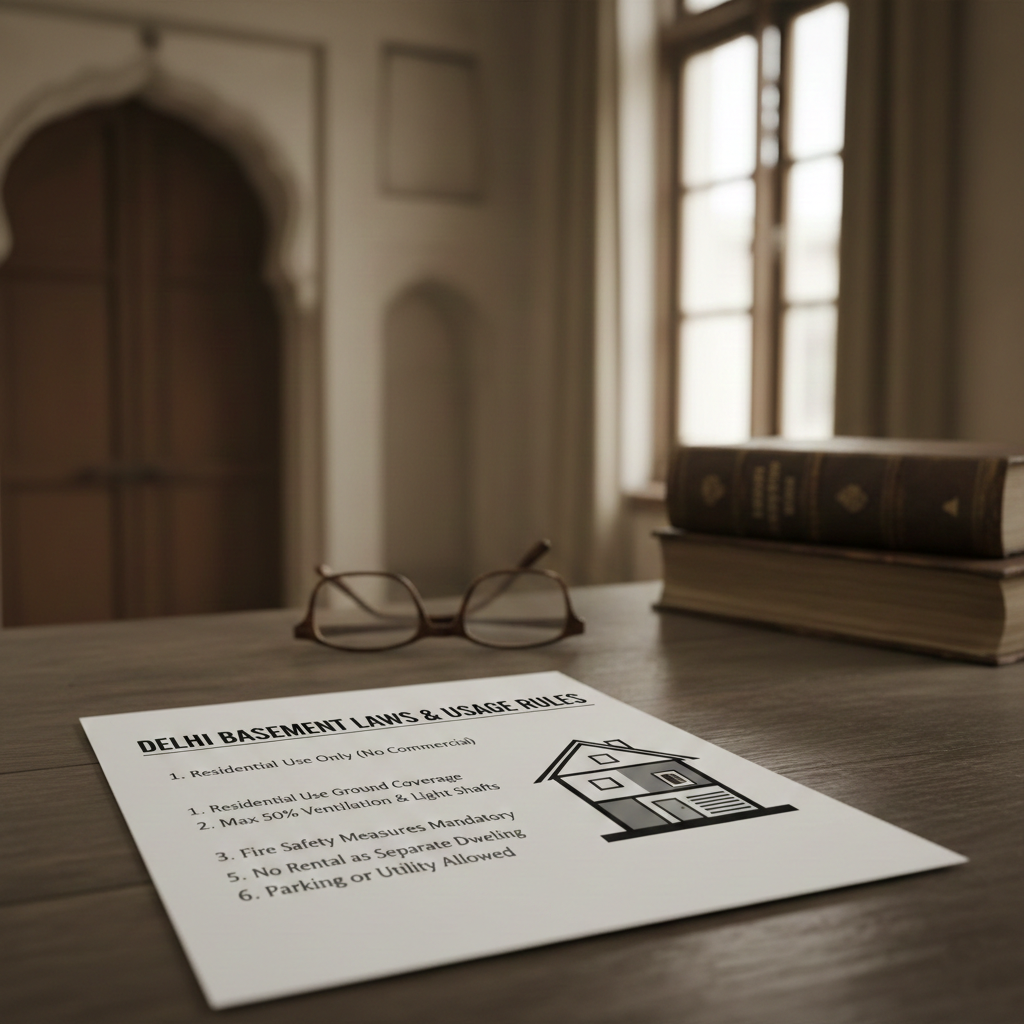
Basements in Delhi are now regulated less by theoretical permissions and more by post-2024 safety enforcement standards. In practice, the Municipal Corporation of Delhi and Delhi Fire Service treat basements as high-risk spaces where human occupancy is discouraged unless the building was designed for it from day one.
1. Educational Use in Basements: Effectively a Total Ban!
Final Legal Reality (2026)
- Residential buildings:
Educational use in basements is completely prohibited.
No approvals, no regularisation, no post-construction conversion. - Commercial buildings:
Even here, Fire Safety Certificates issued in 2025–2026 explicitly restrict educational activity to: “1st floor / 2nd floor only; basement to be used strictly for parking or storage.”
Critical Point
If the original sanctioned building plan does not mark the basement as:
- Assembly
- Educational
- Public occupancy
→ Conversion is now legally impossible, regardless of exits or ventilation.
This is why coaching centres found operating in basements are being sealed immediately, not fined.
2. Fire Safety Systems: Smoke Extraction Is Not Enough!
Mandatory for Basements Above 200 sq. m.
If the basement area exceeds 200 square meters, ALL of the following are compulsory:
- Mechanical smoke extraction system.
- Fire-alarm-linked controls.
- Automatic sprinkler system (non-negotiable).
- Emergency power backup for fire systems.
Even with perfect exits, Fire NOC will be denied without sprinklers.
This is a major change under 2026 DFS inspection standards.
3. Exit Rules: Number + Width + Construction Matter!
For Any Public / Commercial / Professional Use
- Minimum 2 independent exits.
- At least one exit must open directly to open air.
- Staircase width must be at least 1.5 meters (5 feet).
- Staircases must be:
- RCC or non-combustible material.
- Straight or dog-legged (no spiral stairs).
- Fully unobstructed.
A basement with:
- Narrow stairs.
- Wooden staircases.
- Single internal access.
→ Fails fire inspection automatically.
4. Sunken Courtyard (Light Well): A Practical Approval Advantage!
Pro-Tip for Owners.
Authorities now strongly favour basements with sunken courtyards because they:
- Provide natural light.
- Allow direct escape to open sky.
- Reduce the “trapped occupancy” risk.
In borderline cases, a properly designed sunken courtyard significantly improves chances of approval for limited professional use (e.g., architect office, consultancy) on notified mixed-use streets only.
It does not legalise coaching, classrooms, or assembly use.
5. Basement Height: Use-Specific Requirements!
- General basement minimum height:
2.4 meters (clear)- Mechanical / stack parking basements:
Height requirement often increases to 4.5 meters or more, depending on equipment design.This is frequently overlooked during construction and later becomes impossible to fix.
6. Service Installations: Fire Suppression Is Mandatory!
For any basement housing:
- Electrical panels
- DG sets
- UPS rooms
- Large HVAC systems
You must have:
- Automatic fire suppression systems (CO₂ or clean-agent).
- Fire-rated enclosures.
- Dedicated Fire NOC explicitly covering basement services.
“General safety approval” is no longer acceptable.
7. Locks & Access Control: Zero-Tolerance Area!
Strictly Illegal in Basements.
- Biometric locks
- Electronic access systems
that do not fail-safe (auto-unlock) during:- Power cuts
- Fire alarms
- Emergency shutdowns
If DFS finds a lock that can trap occupants:
→ Immediate sealing without noticeInspectors now physically test fail-safe operation.
8. Kitchens & Toilets: No Grey Area Left!
Kitchens :
- LPG / PNG / gas systems: strictly prohibited.
- Risk: gas accumulation (heavier than air).
- No new approvals being granted in 2026.
Toilets :
- Usually only one service toilet allowed.
- Must include:
- Mechanical exhaust.
- Non-return valve for sewer backflow.
- Flood-resistant fittings.
Public or multiple toilets in basements are generally rejected.
9. The 2026 Compliance Checklist (Quick Test)
Does Your Basement Pass?
Feature 2026 Requirement Primary Use Parking, services, or storage only (unless on notified mixed-use street) Educational Use ❌ Completely prohibited in residential basements Exits Minimum 2; one directly to open air Staircase Width ≥ 1.5 m, RCC / non-combustible Fire Safety (>200 sq. m.) Sprinklers + smoke extraction mandatory Locks Fail-safe only (auto-unlock on power failure) Kitchen / Gas ❌ Strictly prohibited Toilets Single service toilet with non-return valve Neighbour Buffer Minimum 2-meter setback from adjacent property wall Sunken Courtyard Strongly recommended for any professional use
In 2026, basements are no longer “flexible spaces.”
They are treated as potential death traps if misused, and enforcement reflects that mindset.
If you’re:
- Buying → verify sanctioned basement use & Fire NOC wording.
- Renting → assume most “commercial basement” listings are illegal.
- Brokering → misrepresentation now carries sealing & liability risk.
Disclaimer:
This article is for general informational purposes based on current enforcement trends. Final approvals depend on sanctioned building plans, site conditions, and authority inspections. Readers should verify with licensed architects or local authorities before taking action.